
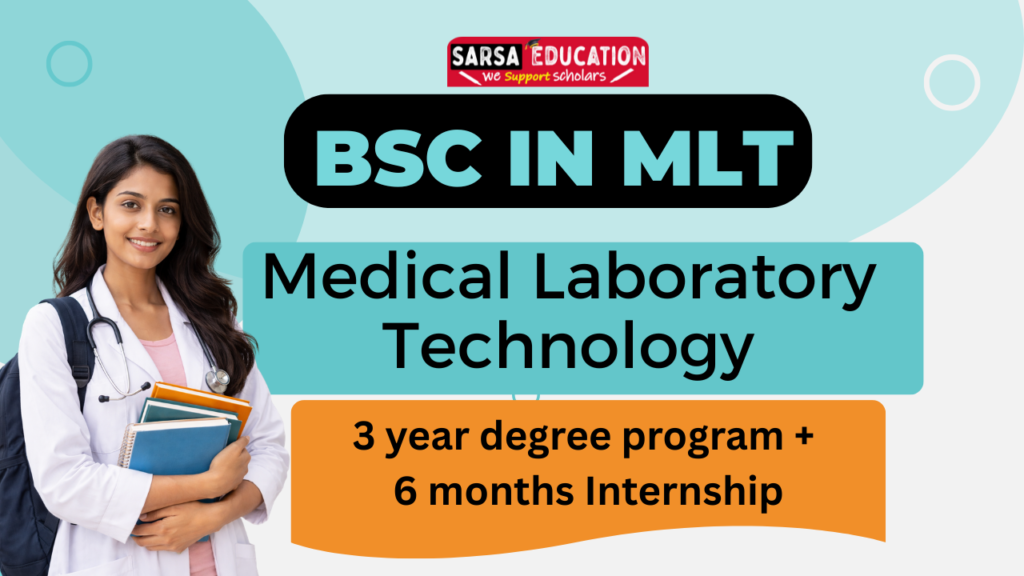
BSc in MLT (Bachelor of Science in Medical Laboratory Technology) is a vital undergraduate program in the healthcare sector that focuses on diagnostic laboratory sciences. This 3-year degree course (plus 6 months internship) prepares students to perform essential laboratory investigations on blood, urine, stool, tissues, and other body samples to assist doctors in detecting, diagnosing, and treating diseases. In modern healthcare, accurate diagnosis forms the foundation of effective treatment, and medical laboratory technologists play a crucial yet often unseen role in this process. The BSc in MLT program equips students with both theoretical knowledge and hands-on laboratory training, making them indispensable contributors to hospitals, diagnostic centers, and research institutions.
The eligibility criteria for BSc in MLT require students to complete 10+2 with Physics, Chemistry, and Biology (PCB) with a minimum of 50% marks. Admission will be merit-based or through entrance examinations, depending on the institution. The course is generally divided into six semesters over three years, followed by a mandatory internship to provide practical exposure. Throughout the program, students are trained to handle advanced laboratory equipment, conduct medical tests, analyze results, and support pathologists and healthcare teams. The curriculum includes specialized subjects such as Hematology, Bacteriology, Immunology, Clinical Endocrinology & Toxicology Lab, Diagnostic Molecular Biology Lab, and Diagnostic Cytology, ensuring comprehensive knowledge of diagnostic sciences.
The growing complexity of healthcare systems has significantly increased the demand for skilled laboratory professionals. Every blood test, biopsy, or pathology report depends on the precision and expertise of trained technologists. BSc in MLT graduates serve as the backbone of diagnostic medicine, working behind the scenes to ensure accurate results that guide medical decisions. With rising cases of chronic diseases and infectious conditions, laboratory testing has become more critical than ever. The course not only focuses on disease diagnosis but also on prevention and treatment monitoring. As healthcare expands across rural and urban areas, the demand for qualified laboratory technologists continues to grow steadily.
Career opportunities after completing BSc in MLT are vast and promising. Graduates can work as Medical Laboratory Technologists, Clinical Laboratory Scientists, Laboratory Managers, and Research Assistants in public and private hospitals, blood donor centers, emergency units, diagnostic laboratories, pharmaceutical companies, research centers, and public health departments. The program is recognized by UGC, paramedical councils, and universities, ensuring credibility and career stability. With the healthcare sector advancing rapidly toward creating a disease-free society, skilled laboratory professionals are more essential than ever. The BSc in MLT course stands out as a job-oriented, future-ready program that blends practical experience with academic excellence, preparing students to become the silent heroes behind every successful medical diagnosis.
Contents
Types of BSc in MLT Courses
BSc in MLT (BSc in Medical Laboratory Technology) courses are broadly divided into three categories: Certificate, Diploma, and Degree courses.
• Certificate Courses:
Certificate in MLT is a short-term course with a duration of 3 to 6 months, which will vary depending on the institution. It focuses on the prevention, diagnosis, and treatment of diseases through basic clinical laboratory testing and procedures.
• Diploma Courses (DMLT):
Diploma in Medical Laboratory Technology (DMLT) is a 2-year paramedical program that can be pursued after completing Class 12 (Science stream). The course emphasizes diagnosing, treating, and preventing diseases using clinical laboratory investigations and other physical tests.
• Degree Courses (BMLT / MMLT):
Degree courses include both Bachelor’s and Master’s programmes in Medical Laboratory Technology. The Bachelor of Medical Laboratory Technology (BMLT) is a 3-year undergraduate degree that allows students to specialize in areas such as microbiology, hematology, pathology, clinical chemistry, immunology, virology, bacteriology, genetics, cytopathology, serology, histology, coagulation, toxicology, radiography, and biomedical techniques.
The Master of Medical Laboratory Technology (MMLT) is a 2-year postgraduate program that offers advanced study in subjects like molecular biology, human anatomy, physiology, and advanced diagnostic techniques.
Why Choose BSc in MLT After Class 12?
Choosing BSc in MLT (Bachelor of Science in Medical Laboratory Technology) after Class 12 is an excellent option for students interested in healthcare, diagnostics, and laboratory science. This course equips students with the technical skills required to perform laboratory tests that help doctors diagnose, treat, and prevent diseases accurately. With rapid advancements in medical technology and the increasing prevalence of lifestyle-related diseases, the demand for skilled professionals is continuously increasing.
1. Job-Oriented and High Demand Career
One of the biggest advantages of pursuing BSc in MLT is that it is a highly job-oriented course. The healthcare industry is growing steadily, creating continuous demand for trained laboratory professionals.
- Growing need due to lifestyle diseases and complex medical conditions
- Strong career outlook and industry growth
- Shortage of skilled lab technicians in many regions
2. Accessible and Affordable Medical Career Option
Compared to courses like MBBS or BDS, BSc in MLT is less competitive and more affordable while still offering strong career prospects.
- Lower tuition fees
- Good return on investment
- Admission after 10+2 (Science stream)
3. Global Career Opportunities
The scope of BSc in MLT is not limited to India. Skilled professionals are in demand in countries like Canada, UAE, UK, and Australia.
- High-paying jobs abroad
- Better work environment
- International exposure
4. Multiple Work Opportunities
Graduates of BSc in MLT can work in:
- Hospitals
- Diagnostic centers
- Pathology labs
- Blood and organ banks
- Research laboratories
- Public health departments
5. Strong Salary Packages and Job Stability
With the increasing demand for diagnostic services, BSc in MLT graduates receive competitive salary packages and enjoy strong job security in the healthcare sector.
6. Science-Based and Practical Curriculum
The BSc in MLT syllabus combines biology, chemistry, pathology, and advanced laboratory technology, providing hands-on training and real-world exposure.
7. Opportunities for Higher Studies
After completing BSc in MLT, students can pursue postgraduate programs and specialized certifications for better career growth and research opportunities.
BSc in MLT is a future-ready, career-oriented program that offers job security, global scope, and professional growth in the healthcare industry.
Eligibility Requirements for BSc in MLT
- Educational Qualification
- Must have completed 10+2 (Intermediate) or equivalent from a recognized board
- Should have a Science stream background (PCB)
- Required Subjects
- Physics
- Chemistry
- Biology (Botany & Zoology)
- Minimum Marks
- Generally, 50% minimum marks in 10+2
- Some colleges accept 45% marks
- Relaxation up to 40% for reserved categories (as per institutional norms)
- Age Criteria
- Candidate must be at least 17 years old
- Age should be completed on or before 31st December of the admission year
Documents Required for BSc in MLT Admission
- 10th & 12th Mark Sheets (Academic proof)
- Transfer Certificate (TC)
- Passport-size Photographs
- Aadhaar Card / Valid ID Proof
- Medical Fitness Certificate

BSc in MLT Admission Process
Admission to BSc in MLT (Bachelor of Science in Medical Laboratory Technology) is offered through merit-based and entrance-based modes, depending on the institution. While many colleges grant direct admission based on Class 12 (Science stream) marks, some reputed universities conduct entrance examinations for selection.
Admission Modes for BSc in MLT
1. Direct Admission (Merit-Based)
- Based on 10+2 marks (PCB – Physics, Chemistry, Biology)
- Cut-off marks vary by college
- Selection depends on academic performance and seat availability
2. Entrance-Based Admission
- Admission granted based on entrance exam score and rank
- Followed by counselling and seat allocation process
3. Direct Admission Support with Sarsa Education
Eligible and interested students seeking direct admission in BSc in MLT can connect with Sarsa Education for expert guidance and admission assistance.
Sarsa Education provides:
- Direct admission assistance
- College and university selection guidance
- Complete documentation support
- Personalized counselling and career advice
Students who meet the eligibility criteria can contact Sarsa Education for further details and secure their admission smoothly in a reputed institution.
Important Links:
Limited chance to unlock Newcastle University Undergraduate Scholarship in 2026
Unlock and secure BYPL Sashakt Scholarship program 2025
Unlock BBA in Real Estate with internship in Dubai in 2026 and secure your dream
Limited Seats! Wekerle International University, Budapest 100% Scholarships
Career Options After BSc in MLT
A BSc in MLT (Bachelor of Science in Medical Laboratory Technology) equips graduates with the skills to work in healthcare, diagnostics, and research laboratories. These professionals play a crucial role in accurate disease detection, patient care, and laboratory management.
Popular Job Roles for BSc in MLT Graduates:
- Medical Lab Technician – Performs routine and specialized laboratory tests in hospitals and diagnostic centers.
- Pathology Technician – Assists in analyzing blood, tissue, and other samples for disease diagnosis.
- Hematology Technician – Conducts blood-related tests and prepares reports for patient treatment.
- Blood Bank Technician – Handles blood collection, testing, storage, and transfusion processes.
- Molecular Lab Technologist – Performs molecular diagnostics, including DNA and RNA testing.
- Biochemistry Technician – Executes biochemical tests to identify metabolic and enzymatic disorders.
- Microbiology Assistant – Analyses microbial samples to detect infections and pathogens.
- CT Scan Technician – Operates CT scan machines and assists in imaging procedures.
- MRI Technician – Handles MRI equipment and interprets imaging results.
- Optical Laboratory Technician – Conducts lab tests related to vision and optical care.
- X-Ray Technician – Performs X-ray imaging for accurate diagnostics.
- Dental Machine Technician – Assists in dental lab operations and equipment handling.
- Radiology Technician – Supports radiology departments in imaging and diagnostic procedures.
- Laboratory Technician / Manager – Oversees lab operations, quality control, and staff supervision.
- Research Associate – Works in clinical and pharmaceutical research projects.
- Lab Assistant – Provides support for daily laboratory operations and sample preparation.
- Laboratory Testing Manager – Monitors lab testing processes, compliance, and accuracy.
Top Recruiting Companies for BSc in MLT Graduates
- Apollo Hospitals
- AIIMS (All India Institute of Medical Sciences)
- Fortis Healthcare
- Manipal Hospitals
- Columbia Asia Referral Hospital
- Batra Hospital and Medical Research Centre, Delhi
- Lilavati Hospital, Mumbai
- Paramount Health Services
- Forensic Science Laboratory
- Cactus Global
Graduates of BSc in MLT have excellent opportunities in these top healthcare and diagnostic organizations, gaining exposure to advanced laboratory practices, diagnostics, and research.
Scope of BSc in MLT
A BSc in MLT (Bachelor of Science in Medical Laboratory Technology) opens wide-ranging opportunities in healthcare, diagnostics, research, and education. Graduates are in high demand in hospitals, diagnostic labs, research centers, and pharmaceutical companies.
- Higher Education:
Graduates can pursue advanced studies to specialize and enhance career prospects:
- MSc in Medical Laboratory Technology
- MSc in Clinical Biochemistry
- MSc in Microbiology
- MSc in Molecular Diagnostics
- PhD in Pathology, Immunology, or Biomedical Sciences
- MBA in Hospital or Lab Management
- PG Diploma in Clinical Pathology
2. Research Opportunities:
BSc in MLT graduates can work in research centers and laboratories in roles such as:
- Biomedical Research Assistant – Support clinical trials and experiments
- Lab Quality Supervisor – Ensure testing standards and accuracy
- Lab Informatics Assistant – Manage lab reports and data systems
3. Abroad Opportunities:
Skilled MLT professionals are in demand globally in countries like Canada, UAE, UK, Germany, and Australia, offering excellent career growth and specialized opportunities.
4. Job & Career Opportunities:
BSc in MLT graduates can pursue multiple specialized roles in hospitals and diagnostic labs:
- Medical Lab Technician
- Pathology Technician
- Hematology Technician
- Blood Bank Technician
- Molecular Lab Technologist
- Laboratory Technician / Manager
Graduates of BSc in MLT enjoy a versatile career path with options in clinical diagnostics, laboratory management, research, and higher studies, both in India and abroad.
Conclusion
The BSc in MLT is a career-focused program in laboratory diagnostics, offering practical training and job opportunities in hospitals, diagnostic labs, and research centers. It provides a strong scientific foundation while preparing graduates for higher studies, specializations, and career growth. Choosing this course ensures skill development, job readiness, and long-term stability in the healthcare sector.

Frequently Asked Questions -BSc in MLT
1. What is BSc in MLT?
BSc in MLT (Bachelor of Science in Medical Laboratory Technology) is a 3-year undergraduate program that trains students in diagnostic laboratory sciences. The course includes a 6-month internship and prepares graduates to perform tests on blood, urine, tissues, and other samples for accurate disease diagnosis.
2. Who is eligible for BSc in MLT?
Students must have completed Class 12 with Physics, Chemistry, and Biology (PCB) with a minimum of 50% marks. Admission can be merit-based or entrance-based, depending on the institution.
3. What is the duration of BSc in MLT?
The BSc in MLT course is generally 3 years, divided into six semesters, plus a mandatory 6-month internship for practical exposure.
4. What are the key subjects in BSc in MLT?
The curriculum covers Hematology, Bacteriology, Immunology, Clinical Chemistry, Toxicology, Molecular Biology, and Diagnostic Cytology, providing comprehensive knowledge in laboratory diagnostics.
5. Why choose BSc in MLT after Class 12?
BSc in MLT offers a job-oriented career in healthcare and diagnostics. It provides hands-on laboratory training, career growth opportunities, and professional stability.
6. What types of BSc in MLT courses are available?
Certificate courses (3–6 months), Diploma courses (DMLT, 2 years), and Degree courses (BMLT 3 years, MMLT 2 years) are available, covering basic to advanced laboratory techniques.
7. What skills are developed in BSc in MLT?
Students develop laboratory handling, sample collection, test analysis, medical instrumentation, data interpretation, and research skills, preparing them for the healthcare industry.
8. What specializations are available in BSc in MLT?
Specializations include Hematology, Microbiology, Pathology, Clinical Chemistry, Immunology, Virology, Bacteriology, Cytopathology, Serology, Histology, Toxicology, and molecular diagnostics.
9. What career opportunities are available after BSc in MLT?
Graduates can work as Medical Lab Technicians, Pathology Technicians, Hematology Technicians, Blood Bank Technologists, Molecular Lab Technologists, Biochemistry Technicians, Microbiology Assistants, and Laboratory Managers.
10. Which sectors hire BSc in MLT graduates?
Hospitals, diagnostic laboratories, blood banks, IVF labs, research laboratories, pharmaceutical companies, public health departments, forensic labs, and government healthcare institutions hire MLT graduates.
11. What are the top recruiting companies for BSc in MLT graduates?
Top employers include Apollo Hospitals, AIIMS, Fortis Healthcare, Manipal Hospitals, Columbia Asia Referral Hospital, Batra Hospital Delhi, Lilavati Hospital Mumbai, Paramount Health Services, Forensic Science Laboratory, and Cactus Global.
12. What is the salary of BSc in MLT graduates?
Entry-level salaries in India range from ₹15,000–₹25,000 per month. With experience, professionals can earn ₹40,000–₹70,000 per month, while international jobs offer higher packages.
13. Is BSc in MLT in demand?
Yes, the demand for BSc in MLT professionals is growing due to the rise in lifestyle diseases, chronic conditions, and advances in diagnostic technologies.
14. Can BSc in MLT graduates pursue higher education?
Graduates can pursue MSc in Medical Laboratory Technology, Clinical Biochemistry, Microbiology, Molecular Diagnostics, PhD in Pathology, Immunology, Biomedical Sciences, MBA in Hospital Management, or PG Diplomas in Clinical Pathology.
15. Are there research opportunities after BSc in MLT?
Yes, graduates can work as Biomedical Research Assistants, Lab Quality Supervisors, Lab Informatics Assistants, or join clinical and pharmaceutical research projects.
16. Can BSc in MLT graduates work abroad?
Yes, countries like Canada, UAE, UK, Germany, and Australia hire trained MLT professionals for diagnostic labs, hospitals, and research centers, providing competitive salaries and career growth.
17. What is the practical exposure in BSc in MLT?
The program provides hands-on training in laboratory techniques, sample analysis, diagnostic equipment handling, and report preparation to meet industry standards.
18. Is BSc in MLT suitable after Class 12?
It is ideal for students interested in healthcare, laboratory diagnostics, research, and clinical sciences, offering career-oriented skills and professional growth.
19. How does BSc in MLT ensure career growth?
Graduates gain practical expertise, specialization options, and higher education opportunities, leading to advanced lab roles, research positions, and international careers.
20. How can students get direct admission in BSc in MLT?
Students can connect with Sarsa Education for direct admission support, college selection guidance, documentation assistance, and personalized counseling for smooth admission into reputed institutions.

For National/International Scholarship updates, kindly join our WhatsApp channel
Follow the Sarsa Education channel on WhatsApp: https://whatsapp.com/channel/0029VaL9SgRAjPXJthnK9D0E
For regular Scholarship/Fellowship/Internship updates:
Join our Telegram channel: Sarsa Education
Email: info@sarsaeducation.com