
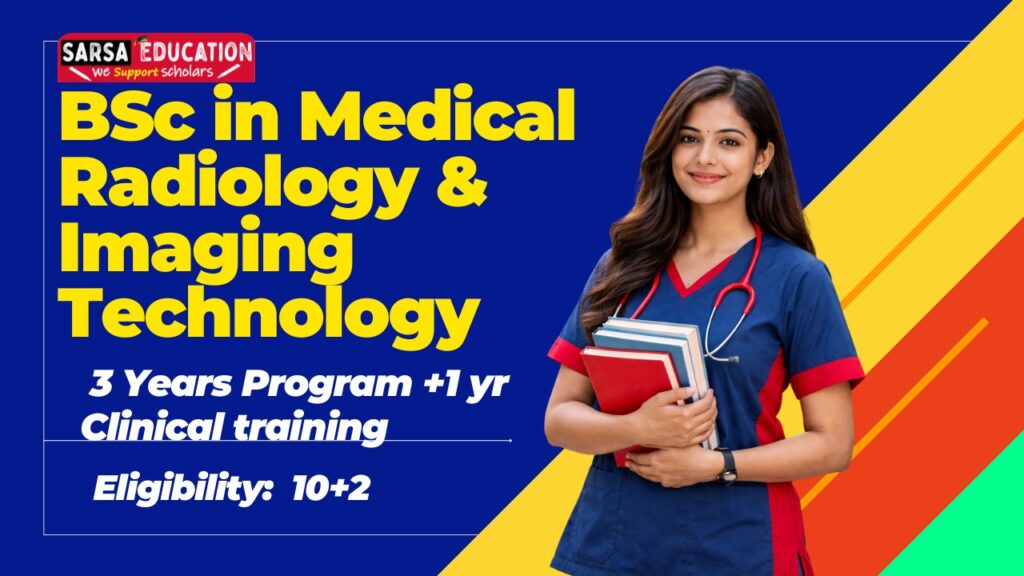
BSc in Medical Radiology and Imaging Technology (MRIT) is an undergraduate paramedical program that prepares students to become skilled allied healthcare professionals in diagnostic imaging services. The course duration is 3 years with 1 year of compulsory internship or 4 years including clinical training, depending on university norms and NCAHP guidelines. The program integrates classroom learning with extensive hands-on clinical exposure to train students in performing imaging procedures such as X-ray, CT Scan, MRI, Ultrasound, Mammography, Fluoroscopy, DEXA, and Angiography.
The curriculum provides comprehensive knowledge of human anatomy, physiology, pathology, radiation physics, and imaging protocols. Students are trained in image acquisition, image processing, patient positioning, radiation safety, quality assurance, and operation of advanced radiological equipment. During clinical rotations, they gain supervised practical experience in whole-body X-rays, interventional procedures such as Barium studies, HSG, RGU, MCU, intravenous procedures, and advanced CT and MRI scanning techniques, enabling them to assist radiologists and physicians in accurate diagnosis and patient management.
Candidates who have passed 10+2 (Senior Secondary Examination) with Physics, Chemistry, and Biology/Mathematics from a recognised board, usually with a minimum of 50% aggregate marks (will vary by institution), are eligible to apply. Admission will be granted based on merit or entrance examination as per university guidelines.
After completing BSc in Medical Radiology and Imaging Technology, graduates can pursue careers as Radiology Technologists, MRI Technicians, CT Technologists, and Imaging Specialists in hospitals, diagnostic centres, and research institutions across India and abroad. The program equips students to handle imaging equipment independently, ensure radiation protection and patient safety, manage emergency situations, and deliver professional, compassionate healthcare services.
Contents
- Why study BSc in Medical Radiology and Imaging Technology (MRIT)?
- Duration:
- Eligibility Criteria
- Important Links:
- Admission Process
- Entrance Exams for – BSc in Medical Radiology and Imaging Technology (MRIT)
- Program Outcomes
- Popular Job Profiles
- Top Recruiters
- Scope
- Conclusion
- FAQs – BSc in Medical Radiology and Imaging Technology (MRIT)
Why study BSc in Medical Radiology and Imaging Technology (MRIT)?
BSc in Medical Radiology and Imaging Technology (MRIT) is a career-focused paramedical program designed for students who want to build a future in the fast-growing field of diagnostic imaging. With the increasing demand for accurate and early disease detection, medical imaging has become a vital part of modern healthcare. This program equips students with technical expertise, clinical skills, and professional knowledge required to work efficiently in radiology and imaging departments.
- Specialized Knowledge in Diagnostic Imaging: The course provides in-depth understanding of imaging procedures used to capture internal body structures and assist in diagnosing and treating various diseases and disorders.
- Comprehensive Practical Training: Students receive hands-on experience through laboratory sessions, clinical rotations in radiology departments, and simulation-based learning across multiple modalities such as X-ray, CT, MRI, mammography, fluoroscopy, and ultrasound assistance.
- Strong Career Opportunities: Graduates can work in hospitals, diagnostic centres, trauma care units, and specialised imaging facilities, as the demand for qualified radiology technologists continues to grow in India and abroad.
- Competitive Starting Salary: The average initial salary after completing the course ranges from INR 1,00,000 to INR 1,50,000 per year, offering stable earning potential compared to many other entry-level programs.
- Technology-Driven Healthcare Career: The program allows students to work at the intersection of physics, advanced imaging software, and patient care in modern radiology departments.
- Future-Ready Skill Development: Training includes exposure to digital imaging systems, DICOM standards, PACS/RIS platforms, and quality assurance procedures, preparing students for advanced healthcare technologies.
- Opportunities for Higher Education and Career Growth: After graduation, students can pursue master’s degrees and research programs in radiology and imaging technology, enhancing their academic profile and increasing salary prospects.
- Professional Competency and Ethical Practice: The course develops problem-solving, critical thinking, communication skills, and ethical behaviour, ensuring graduates deliver quality, patient-focused care as competent entry-level technologists.
Program Level:
Undergraduate
Duration:
4 Years (3 Years + 1 Year Clinical Training / Internship)
Eligibility Criteria
Candidates applying for BSc Medical Radiography and Imaging Technology must meet the following eligibility requirements as per NCAHP National Commission for Allied and Healthcare Professions norms and institutional guidelines. Applicants should carefully review the criteria before applying, as requirements will vary slightly from college to college.
- Academic Qualification
- Candidates must have passed the Senior Secondary Examination (10+2) from a recognized Board.
- Students must have completed 10+2 in the Science stream with Physics, Chemistry, and Biology (PCB) as compulsory subjects.
- A minimum of 50% aggregate marks in Physics, Chemistry, and Biology (PCB) is required.
- Age Limit
- The candidate must have completed 17 years of age on or before 31st December of the year of admission.
- The minimum age is 17 years, and the maximum age is 21 years as on December 31st of the admission year (where applicable).
- Medical Fitness Requirement
- Submission of a Medical Fitness Certificate certified by a Government Medical Officer is mandatory at the time of admission.
- Entrance Examination (If Applicable)
- For admission to top colleges, candidates will be required to qualify National-level or University-level entrance examinations.
- Lateral Entry Eligibility
- Candidates must have secured a minimum of 50% marks in Diploma in MRIT from a recognized institute to be eligible for lateral entry.
Note: The eligibility requirements will differ slightly depending on the college or university.
Important Links:
incredible Dhirubhai Ambani Scholarship [Up to Rs 40,500 per year]
unlock Aditya Birla Scholarship for MBA Students 2026, don’t miss it
Incredible OP Jindal Scholarship for Engineering & MBA students 2026
incredible IDFC FIRST Bank MBA Scholarship [Up to Rs 2 Lakh]
Admission Process
The admission process for BSc Medical Radiography and Imaging Technology is conducted as per institutional guidelines and will vary slightly from college to college. Candidates must ensure they meet the eligibility criteria before applying. The step-by-step admission procedure is outlined below:
Step 1: Check Eligibility Criteria
Candidates must verify that they have completed 10+2 in the Science stream with Physics, Chemistry, and Biology, securing the required minimum aggregate marks as specified by the institution.
Step 2: Fill the Application Form
Applicants need to complete the admission application form either online through the official college/university website or offline by visiting the campus.
Step 3: Appear for Entrance Examination (If Applicable)
Some universities and top colleges conduct National-level or University-level entrance examinations. Candidates must qualify for the required entrance test if applicable.
Step 4: Merit List or Entrance Result Declaration
Admission is granted based on merit in the qualifying examination (10+2 marks) or performance in the entrance examination, depending on the institution’s selection criteria.
Step 5: Counselling and Document Verification
Shortlisted candidates are called for counselling and must submit required documents for verification, including academic certificates, identity proof, and other necessary records.
Step 6: Medical Fitness Certificate Submission
Candidates must submit a Medical Fitness Certificate certified by a Government Medical Officer at the time of admission.
Step 7: Fee Payment and Final Admission Confirmation
After successful document verification and counselling, candidates are required to pay the prescribed course fee to confirm their admission.
Step 8: Direct Admission with SARSA EDUCATION
Sarsa Education provides expert support for direct admission (subject to eligibility and college norms), scholarship assistance, and professional career counselling to help students choose the best institution and plan a successful career in BSc in Medical Radiology and Imaging Technology. Connect us for more details.
Entrance Exams for – BSc in Medical Radiology and Imaging Technology (MRIT)
Admission to BSc in Medical Radiography and Imaging Technology in certain universities and institutions will require candidates to qualify for National-level or University-level entrance examinations. These exams assess the candidate’s academic knowledge and aptitude for the program.
Some of the popular entrance exams include:
- NPAT
- CUET
- CUCET
- SET

Program Outcomes
- Clinical Care: Apply core knowledge of Medical Radiology and Imaging Technology, including ethics, good lab practice, quality control, and patient safety.
- Communication Skills: Develop effective communication with patients, caregivers, healthcare professionals, and community members for accurate investigation and reporting.
- Team Membership: Work collaboratively within a multidisciplinary healthcare team with transparency in decisions, uncertainties, and outcomes to achieve accurate patient results.
- Ethics and Accountability: Follow ethical principles and clinical laws to practice responsibly as healthcare service providers in Medical Lab Technology.
- Professional Excellence: Demonstrate technical competence, confidence, empathy, compassion, effective communication, and a non-discriminatory attitude to ensure safe and quality healthcare delivery.
- Leadership and Mentorship: Adapt leadership roles when required and respond confidently to planned or unexpected clinical situations to ensure patient satisfaction.
- Social Responsibility: Recognize the role of allied healthcare professionals as advocates within the healthcare system and manage resources responsibly.
- Scientific and Scholarly Approach: Apply scientific principles in patient care, research activities, and professional interactions.
- Lifelong Learning: Engage in continuous and independent learning to remain committed to patient care and health improvement.
Popular Job Profiles
Graduates of BSc Medical Radiography and Imaging Technology can work in the following roles:
- Medical Radiology and Imaging Technologist
- Radiographer
- Radiological Technologist
- X-ray Technologist
- CT Scan Technologist
- MRI Technologist
- Mammography Technologist
- Diagnostic Medical Sonographer
- Fluoroscopy Technologist
- Interventional Radiology Technologist
- DEXA Scan Technologist
- Interventional Radiology Assistant
- Radiology Quality & Safety Officer
- Imaging Informatics / PACS Executive
- Academic & Research Assistant (with higher studies)
Top Recruiters
Graduates of BSc Medical Radiography and Imaging Technology are recruited by leading hospitals, diagnostic centres, and healthcare organizations, including:
- Apollo Hospitals
- Hosmat Hospitals
- NIMHANS
- Max Hospital
- Aster Healthcare
- Government Hospitals
- AIIMS
- Dr. Reddy’s Path Labs
- Padma Shree Diagnostic Centres
- Fortis Hospital
These organizations offer strong career opportunities in radiology, diagnostic imaging, and allied healthcare services.
Scope
BSc Medical Radiography and Imaging Technology offers diverse career opportunities in hospitals, diagnostic centres, research institutions, and independent practice across government and private sectors.
1. Job Opportunities
Graduates can work in roles such as:
- Medical Radiology and Imaging Technologist / Radiographer
- CT Scan / MRI / Ultrasound Technologist
- Mammography or Nuclear Medicine Technologist
- Interventional Radiology Technologist
- PACS / Imaging Informatics Executive
- Radiation Safety Officer (RSO)
- Hospital Radiology Administrator or Medical Imaging Educator
2. Higher Education and Research
- Pursue M.Sc. in Medical Radiology and Imaging Technology for advanced specialization.
- Opt for Ph.D. programs to enter research and academic fields.
- Work as a Medical Imaging Researcher or specialize in advanced imaging modalities.
3. Self-Employment
- Establish an independent clinical laboratory or diagnostic centre after gaining experience and required approvals.
- Provide specialized diagnostic imaging services in collaboration with healthcare providers.
Conclusion
In conclusion, BSc in Medical Radiology and Imaging Technology (MRIT) is a comprehensive undergraduate program that prepares students to become skilled allied healthcare professionals in the field of diagnostic imaging. With strong academic foundations, extensive clinical training, and exposure to advanced imaging technologies, graduates are well-equipped to support accurate diagnosis and patient care. The program offers excellent career opportunities, options for higher education and research, and scope for independent practice. As the demand for quality diagnostic services continues to grow, MRIT remains a promising and future-focused healthcare career choice.
FAQs – BSc in Medical Radiology and Imaging Technology (MRIT)
1. What is BSc in Medical Radiology and Imaging Technology (MRIT)?
BSc in Medical Radiology and Imaging Technology (MRIT) is an undergraduate paramedical program that trains students to become skilled allied healthcare professionals in diagnostic imaging services. The course focuses on imaging procedures such as X-ray, CT scan, MRI, Ultrasound, Mammography, Fluoroscopy, DEXA, and Angiography. It combines classroom learning with clinical training, emphasizing radiation safety, patient care, and accurate image acquisition for effective diagnosis.
2. What is the duration of BSc in Medical Radiology and Imaging Technology?
The duration of BSc in Medical Radiology and Imaging Technology (MRIT) is typically 4 years (3 years academic study + 1-year compulsory internship/clinical training). Some universities follow a 3+1 year structure as per institutional norms and NCAHP guidelines. The internship provides hands-on hospital-based training under supervision.
3. What are the eligibility criteria for BSc in Medical Radiology and Imaging Technology?
To apply for BSc in Medical Radiology and Imaging Technology (MRIT), candidates must have:
- Passed 10+2 (Senior Secondary Examination) from a recognized board
- Studied Physics, Chemistry, and Biology (PCB) in the Science stream
- Secured a minimum of 50% aggregate marks in PCB (will vary by institution)
- Met age criteria and medical fitness requirements as per institutional and NCAHP norms
4. Is there an age limit for admission?
Yes. For admission to BSc in Medical Radiology and Imaging Technology (MRIT):
- Minimum age: 17 years (on or before 31st December of admission year)
- Maximum age: Up to 21 years (where applicable as per institutional norms)
Applicants should confirm specific age requirements with the respective institution.
5. Is an entrance exam required?
Admission to BSc in Medical Radiology and Imaging Technology (MRIT) will be based on:
- Merit (10+2 marks), or
- National-level / University-level entrance examinations
Popular entrance exams include NPAT, CUET, CUCET, and SET. Requirements vary by institution.
6. What subjects are included in the curriculum?
The curriculum of BSc in Medical Radiology and Imaging Technology (MRIT) includes:
- Human Anatomy & Physiology
- Pathology
- Radiation Physics
- Radiographic Positioning & Imaging Techniques
- Radiation Safety & Quality Assurance
- Image Acquisition & Processing
The program ensures theoretical knowledge + practical competency in advanced radiological equipment.
7. What practical training is provided?
Students receive extensive hands-on clinical training, including:
- Whole-body X-rays
- CT and MRI scanning techniques
- Ultrasound assistance
- Barium studies, HSG, RGU, MCU
- Intravenous and interventional procedures
Clinical rotations help students gain real-time hospital experience under supervision.
8. What skills are developed during the course?
BSc in Medical Radiology and Imaging Technology (MRIT) develops:
- Technical expertise in imaging equipment handling
- Patient positioning and radiation protection skills
- Emergency management abilities
- Communication and teamwork skills
- Ethical and professional conduct
Graduates are trained to ensure safe, accurate, and high-quality diagnostic imaging services.
9. What are the career opportunities after BSc in Medical Radiology and Imaging Technology?
Graduates can work as:
- Radiology Technologist / Radiographer
- CT Technologist
- MRI Technologist
- Mammography Technologist
- Imaging Specialist
Employment is available in hospitals, diagnostic centres, trauma units, and research institutions in India and abroad.
10. Can graduates work independently?
Yes. Graduates of BSc in Medical Radiology and Imaging Technology (MRIT) are trained to operate imaging equipment independently under professional guidelines. With required approvals and experience, they can establish diagnostic centres or clinical laboratories, following radiation safety and regulatory norms.
11. Is BSc in Medical Radiology and Imaging Technology a good career option?
Yes. BSc in Medical Radiology and Imaging Technology (MRIT) is a technology-driven healthcare career with increasing demand due to the growing need for early and accurate disease diagnosis. The field offers career stability, specialization opportunities, and long-term professional growth.
12. What higher education options are available?
After completing BSc in Medical Radiology and Imaging Technology (MRIT), students can pursue:
- M.Sc. in Medical Radiology and Imaging Technology
- Ph.D. programs in imaging and healthcare research
Higher education enables advanced specialization, academic careers, and research opportunities.
13. What is the role of NCAHP in this program?
The National Commission for Allied and Healthcare Professions (NCAHP) regulates allied health programs like BSc in Medical Radiology and Imaging Technology (MRIT). Institutions follow NCAHP norms for curriculum structure, duration, internship, and professional standards, ensuring uniform quality education and competency.
14. What is included in the internship?
The 1-year compulsory internship includes:
- Performing imaging procedures under supervision
- Assisting radiologists in diagnostic investigations
- Exposure to advanced CT and MRI modalities
- Strengthening clinical skills and professional confidence
The internship prepares students for real-world radiology department responsibilities.
15. How is BSc in Medical Radiology and Imaging Technology different from other paramedical courses?
BSc in Medical Radiology and Imaging Technology (MRIT) is distinct because it combines:
- Medical science + radiation physics + advanced imaging technology
- Training in digital imaging systems, DICOM standards, PACS/RIS platforms
- A strong focus on diagnostic accuracy and patient safety
It is a highly specialized, technology-oriented healthcare program aligned with modern medical advancements.
For National/International Scholarship updates, kindly join our WhatsApp channel
Follow the Sarsa Education channel on WhatsApp: https://whatsapp.com/channel/0029VaL9SgRAjPXJthnK9D0E
For regular Scholarship/Fellowship/Internship updates:
Join our Telegram channel: Sarsa Education
Email: info@sarsaeducation.com