

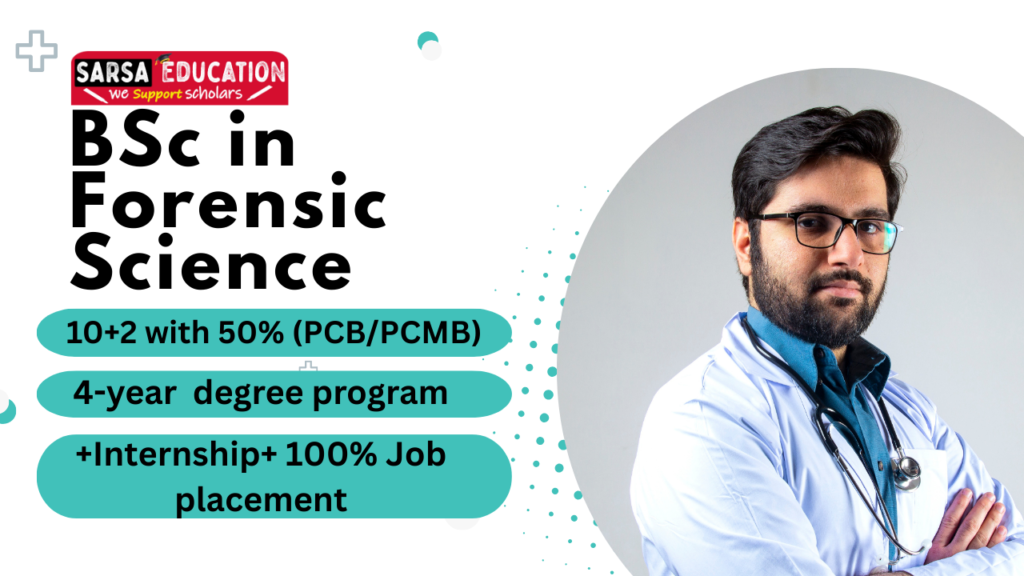
BSc in Forensic Science (Hons.) is a specialized 4-year undergraduate degree program designed to equip students with scientific knowledge and practical skills required for crime investigation and evidence analysis. This course focuses on the application of scientific principles in criminal investigations, blending core subjects such as biology, chemistry, physics, and law. The program prepares students to examine crime scenes, analyze physical evidence, and support the justice system through accurate and ethical forensic practices.
The BSc in Forensic Science curriculum integrates theoretical learning with hands-on laboratory training, field exposure, internships, and case-based studies. Students gain expertise in areas such as crime scene investigation, forensic toxicology, DNA profiling, fingerprint analysis, digital forensics, ballistics, forensic biology, and forensic chemistry. By combining scientific techniques with legal knowledge, the program ensures that graduates can handle real-world criminal cases with precision and professionalism.
One of the key strengths of this program is its strong emphasis on research, analytical thinking, and ethical responsibility. Students are trained in research methodology, data analysis, evidence interpretation, and scientific reporting, enabling them to contribute effectively to forensic laboratories and investigative agencies. The course also enhances critical thinking, problem-solving abilities, and decision-making skills required in high-pressure investigative environments.
After completing a BSc in Forensic Science, graduates can pursue career opportunities in forensic laboratories, law enforcement agencies, crime investigation departments, judiciary support systems, intelligence agencies, and private investigation firms. Students can also opt for higher education such as MSc in Forensic Science or specialized research programs to expand their expertise. With the increasing demand for scientific crime investigation, BSc in Forensic Science offers promising career growth and professional stability in the field of justice and public safety.
Contents
Why Should You Study BSc in Forensic Science?
Choosing Forensic Science as a career path offers a unique combination of science, investigation, and justice. This program equips students with scientific expertise, analytical thinking, and practical skills required to solve crimes and support the legal system. Below are the key reasons why pursuing BSc in Forensic Science can be a rewarding and future-oriented decision:
1. Skill Development Through BSc in Forensic Science
Pursuing BSc in Forensic Science helps students develop essential investigative and technical skills required in criminal investigations. The program trains students in crime scene investigation, evidence collection and preservation, and accurate evidence analysis. Students also learn to operate forensic laboratory equipment, conduct chemical and biological tests, and interpret scientific data. Overall, BSc in Forensic Science equips learners to apply scientific methods effectively in solving crimes and supporting legal proceedings.
2. Knowledge Enhancement in Multiple Disciplines
BSc in Forensic Science provides knowledge across various disciplines, including psychology, psychiatry, scientific principles, and legal procedures. Students gain understanding of crime-related terminology, ethical standards, and courtroom practices. The program combines theory with practical experience, preparing students to handle forensic responsibilities with professionalism and integrity.
3. Wide Career Opportunities After BSc in Forensic Science
A degree in BSc in Forensic Science offers diverse career opportunities in law enforcement agencies, forensic laboratories, research institutions, healthcare sectors, and academia. Graduates can work as crime scene investigators, DNA analysts, fingerprint experts, forensic toxicologists, or intelligence analysts. The course also creates pathways for higher education and research, making BSc in Forensic Science a strong and career-focused choice.
4. High Demand for Forensic Professionals
With the continuous rise in traditional, digital, and organized crimes, the demand for qualified professionals with a BSc in Forensic Science is increasing. Law enforcement agencies and forensic laboratories require trained experts who can provide scientific evidence to assist investigations and court proceedings.
5. Diverse and Specialized Career Paths
After completing BSc, graduates can specialize in fields such as DNA analysis, ballistics, forensic pathology, cyber forensics, and toxicology. Opportunities are available in India and abroad, including organizations like CBI, NIA, IB, CFSL, FSL, and international agencies such as Interpol.
6. Make a Meaningful Contribution to Society
One of the strongest reasons to pursue BSc in Forensic Science is the opportunity to contribute to justice and public safety. Forensic professionals play a vital role in ensuring that the guilty are punished and the innocent are protected through scientific evidence rather than assumptions.
7. Strong Scientific and Cognitive Development
The BSc in Forensic Science program strengthens analytical thinking, logical reasoning, attention to detail, and focused concentration. It enhances problem-solving skills, report writing abilities, courtroom testimony skills, and understanding of legal and ethical standards.
8. Unique Interdisciplinary Learning Experience
BSc in Forensic Science is a unique interdisciplinary course that combines biology, chemistry, physics, law, psychology, and criminology. Students receive hands-on training in forensic techniques such as DNA profiling, fingerprinting, toxicology testing, and crime scene analysis, making it both academically engaging and professionally valuable.

Eligibility Criteria
- Basic Eligibility
Candidates seeking admission to the BSc in Forensic Science program must meet the following requirements:
- Must have passed Senior Secondary Examination (10+2) or equivalent from a recognised board.
- Must belong to the Science stream.
- Should have studied Physics, Chemistry, and Biology / Mathematics (PCB or PCMB) in Class 12.
- Must have secured a minimum aggregate of 50% marks in 10+2.
- Students who have completed a 3-year Polytechnic Diploma are also eligible to apply.
- There is no upper age limit for applying to BSc Forensic Science in India.
- Skills & Interests Required
2. This program is most suitable for students who:
- Are interested in forensic analysis, crime investigation, and solving cases.
- Have a strong academic background in Biology, Chemistry, Mathematics, and Physics.
- Are meticulous, detail-oriented, and skilled in analysing data.
- Possess critical thinking and problem-solving abilities.
- Have a genuine interest in understanding crimes and pursuing forensic science as a profession.
Admission Process
Admission to the BSc Forensic Science program will be conducted through merit-based selection or entrance examination, depending on the college or university. Candidates can apply through online or offline application modes as specified by the institution.
Step 1: Check Eligibility Criteria
Candidates must first ensure they meet the required eligibility conditions set by the college or university. Only eligible applicants who have completed 10+2 in the Science stream can proceed further.
Step 2: Choose Colleges/Universities
Applicants should decide the institutions where they wish to apply, including government, private, or specialised colleges. Admission procedures will vary slightly across institutions.
Step 3: Fill Out the Application Form
Candidates must register and complete the application form either online or offline by providing personal, academic, and contact details. Required documents such as mark sheets, photographs, and certificates must be uploaded or submitted.

Step 4: Pay the Application / Registration Fee
Applicants must pay the prescribed registration fee and any additional charges required by the institution. The application is considered complete only after successful fee payment.
Step 5: Entrance Exam (If Applicable)
Some colleges conduct entrance examinations, and candidates must appear and secure marks as per the required cut-off. Preparation generally includes revising Class 12 science subjects and practising relevant topics.
Step 6: Merit-Based Selection (If No Entrance Exam)
Many institutions grant admission based on 10+2 qualifying examination marks. Candidates are shortlisted according to their academic performance and previous relevant records.
Step 7: Declaration of Results and Merit List
Entrance exam results are declared within a specified timeframe by examination authorities. Colleges publish merit lists based on exam scores or qualifying examination performance.
Step 8: Document Verification
Shortlisted candidates must submit original documents for verification to confirm eligibility. Required documents include mark sheets, certificates, ID proof, photographs, and scorecards (if applicable).
Step 9: Admission Fee Payment and Seat Confirmation
After verification, candidates must pay the admission or first-semester fee within the given deadline. This confirms the allotted seat in the program.
Step 10: Final Admission and Course Commencement
Candidates receive the official admission confirmation letter from the institution. Students then attend orientation and begin classes as per the academic schedule.
Job Roles You Can Apply For
- Forensic Scientist / Analyst – Examine evidence and prepare scientific reports.
- Crime Scene Investigator – Visit crime scenes, collect samples, and document findings.
- DNA Analyst – Study biological samples to help identify individuals.
- Forensic Toxicologist – Test for drugs, chemicals, or toxins.
- Crime Laboratory Analyst – Analyse evidence using laboratory techniques.
- Cyber Forensics Analyst – Investigate cybercrimes and recover digital data.
- Questioned Document Examiner – Detect fake documents and analyse handwriting.
- Drug Analyst – Study and identify chemical substances and narcotics.
- Forensic Auditor – Investigate financial fraud and misconduct.
- Forensic Expert – Use scientific methods to support criminal investigations.
- Crime Reporter – Research and report crime-related news.
- Research or Lab Assistant – Support scientific work in labs and institutions.
Scope After BSc in Forensic Science
- Growing Demand
The demand for professionals with a BSc in Forensic Science is increasing due to the rising number of criminal cases and the need for scientific investigation. Forensic experts play an important role in identifying offenders through laboratory analysis of evidence, making them essential to modern law enforcement systems.
- Career Opportunity
Graduates can work in both public and private sectors after completing BSc in Forensic Science. Career roles include forensic scientists, investigative officers, forensic accountants, cyber forensic experts, and legal support professionals. Employment opportunities are available in forensic laboratories, investigation agencies, and corporate organisations dealing with fraud and security.
- Higher Education
Students who wish to continue learning after BSc in Forensic Science can pursue postgraduate studies and specialise further in forensic and allied sciences. Advanced qualifications can lead to teaching, academic, or expert-level positions in the field.
- Research & Development (R&D)
The field offers opportunities to contribute to research and development by improving forensic techniques, evidence analysis methods, and investigative technologies. Professionals will assist in laboratory research, innovation, and scientific advancements that strengthen the criminal justice system.
- Less Competitive Field
Since fewer students enrol in BSc in Forensic Science compared to other science programs, it is considered a less competitive field. This creates favourable career prospects and allows graduates to build stable and meaningful careers combining science, technology, and law.

Conclusion
BSc in Forensic Science is a career-focused undergraduate program that combines scientific knowledge with practical investigative skills to support modern crime detection and justice. It provides a strong foundation in subjects like biology, chemistry, and physics, while introducing students to evidence analysis, crime scene investigation, and laboratory techniques. The course emphasizes both theoretical understanding and hands-on training, helping students develop accuracy, observation skills, and logical thinking required in real-life investigations.
With the growing demand for scientific methods in solving crimes, this field offers good career opportunities in forensic laboratories, investigation agencies, legal support services, and private organisations. It is also considered a comparatively less competitive field, making it a suitable option for students who are interested in science and want to build a meaningful career contributing to society through evidence-based work.
Frequently Asked Questions (FAQs) – BSc in Forensic Science
1. What is BSc in Forensic Science?
BSc in Forensic Science is a specialized undergraduate program that teaches students how scientific methods are used to investigate crimes. It combines subjects like biology, chemistry, physics, and law to help students understand evidence analysis and crime scene investigation.
2. What is the duration of BSc in Forensic Science?
BSc in Forensic Science (Hons.) is typically a 4-year degree program divided into semesters. The course includes classroom learning, laboratory work, internships, and project-based training to give students both theoretical knowledge and practical exposure.
3. Who can apply for BSc in Forensic Science?
Students who have completed 10+2 in the Science stream with Physics, Chemistry, and Biology or Mathematics can apply for BSc in Forensic Science. Most institutions require at least 50% marks, though eligibility may vary slightly by college.
4. What subjects are taught in BSc in Forensic Science?
The BSc in Forensic Science curriculum includes forensic biology, forensic chemistry, toxicology, DNA analysis, cyber forensics, ballistics, criminal law, fingerprint analysis, and crime scene management, providing a strong interdisciplinary understanding of investigations.
5. Is BSc in Forensic Science a practical-oriented course?
Yes, BSc in Forensic Science emphasizes hands-on learning. Students work in laboratories, handle simulated evidence, attend workshops, and participate in internships to gain real-world experience in forensic techniques and scientific investigations.
6. What skills can students gain from BSc in Forensic Science?
Students develop analytical thinking, observation skills, problem-solving ability, scientific reporting, and evidence interpretation. BSc in Forensic Science also strengthens attention to detail and logical reasoning, which are essential in criminal investigations.
7. What career options are available after BSc in Forensic Science?
Graduates can work as forensic analysts, crime scene investigators, DNA experts, toxicology assistants, cyber forensic analysts, or laboratory technicians. BSc in Forensic Science opens opportunities in investigation agencies, labs, and security organizations.
8. Is there a demand for professionals with BSc in Forensic Science?
Yes, with increasing crime rates and the need for scientific investigation, the demand for trained graduates of BSc in Forensic Science is steadily rising. Law enforcement and forensic laboratories require skilled professionals to analyze evidence accurately.
9. Can students pursue higher education after BSc in Forensic Science?
After completing BSc in Forensic Science, students can pursue MSc programs, specialized certifications, or research-based studies. Higher education allows deeper specialization in areas such as DNA profiling, toxicology, or digital forensics.
10. Is BSc in Forensic Science suitable for students interested in research?
Yes, BSc in Forensic Science builds a strong foundation in research methodology, data analysis, and scientific documentation. Students interested in innovation and laboratory research can later contribute to forensic advancements and investigative technologies.
11. Does BSc in Forensic Science include internship opportunities?
Most institutions offering BSc in Forensic Science include internships, allowing students to work with laboratories or investigative departments. This practical exposure helps them understand professional procedures and strengthens employability.
12. Is mathematics compulsory for BSc in Forensic Science?
Mathematics is not always mandatory. Students with either Biology or Mathematics in Class 12 are usually eligible for BSc in Forensic Science, depending on institutional requirements.
13. What makes BSc in Forensic Science different from other science degrees?
Unlike traditional science programs, BSc in Forensic Science focuses on applying scientific knowledge to legal investigations. It uniquely integrates science with criminology and law, preparing students for roles directly connected to justice and public safety.
14. Is BSc in Forensic Science a challenging course?
BSc in Forensic Science requires dedication, observation skills, and scientific understanding. While it can be academically demanding, students who enjoy science and investigation often find the course engaging and rewarding.
15. Can BSc in Forensic Science lead to government jobs?
Yes, graduates of BSc in Forensic Science can apply for roles in government forensic laboratories, investigation departments, and public safety organizations through recruitment processes and competitive examinations.
16. Are there opportunities in the private sector after BSc in Forensic Science?
Private forensic labs, cybersecurity firms, insurance companies, and legal consultancies also hire graduates of BSc in Forensic Science for fraud detection, digital investigations, and technical analysis.
17. Is BSc in Forensic Science a good career choice for the future?
With technological advancements and the increasing reliance on scientific evidence, BSc in Forensic Science offers strong career potential, stability, and meaningful work contributing to justice and societal safety.
18. What qualities are important for students pursuing BSc in Forensic Science?
Students should be curious, detail-oriented, ethical, and patient. BSc in Forensic Science requires careful observation, accurate documentation, and the ability to analyze situations logically without bias.
19. Is the field of BSc in Forensic Science highly competitive?
Compared to many traditional degree programs, BSc in Forensic Science has fewer enrollments, making it relatively less competitive while still offering specialized and valuable career opportunities.
20. How does BSc in Forensic Science contribute to society?
BSc in Forensic Science enables professionals to support the justice system by analyzing evidence scientifically. Their work helps identify offenders, prevent wrongful accusations, and ensure fair legal outcomes, making it a socially impactful career path.

For National/International Scholarship updates kindly join our whatsApp channel
Follow the Sarsa Education channel on WhatsApp: https://whatsapp.com/channel/0029VaL9SgRAjPXJthnK9D0E
In case of any queries, please reach out to:
+91-9156405182 (Monday to Friday – 10:00AM to 06:00 PM (IST))