
The LLB (Bachelor of Laws) is one of the most popular undergraduate law degrees for students who aspire to build a career in the legal field. The term LLB stands for Legum Baccalaureus, a Latin phrase meaning Bachelor of Laws. The double “LL” in the abbreviation represents the plural form of the word law in Latin. An LLB course provides students with a comprehensive understanding of the legal system, government policies, and constitutional laws while developing essential skills such as analytical thinking, evaluation, and decision-making required to handle legal matters effectively.
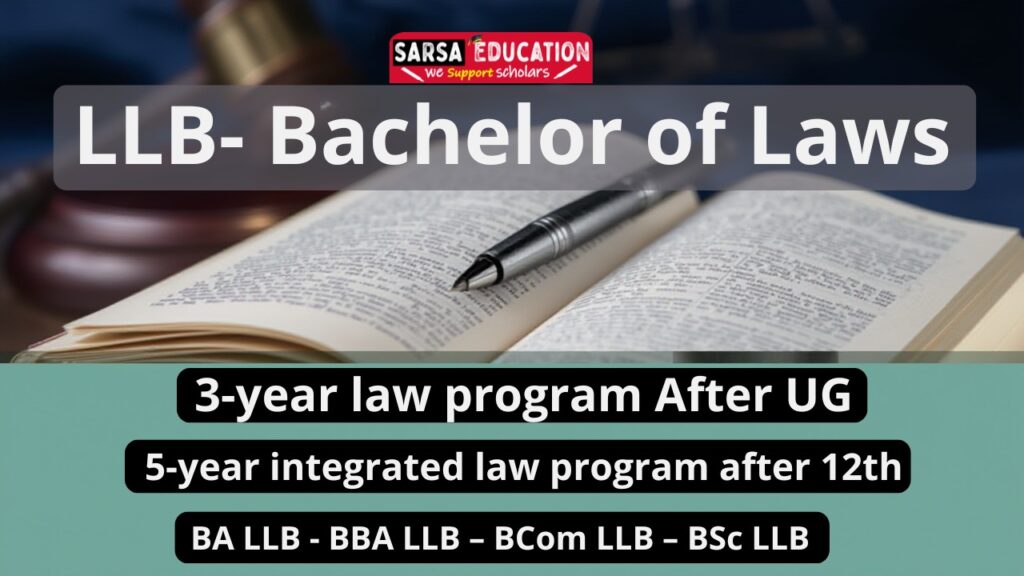
An LLB degree can be pursued either as a 3-year undergraduate law program after graduation or as a 5-year integrated law course after completing 12th grade. The integrated programs allow students to gain knowledge in both law and another field of study. The curriculum of course covers important subjects like constitutional law, criminal law, contract law, administrative law, jurisprudence, international law, and legal research and writing.

Students who wish to pursue course often need to appear for national or university-level entrance examinations such as CLAT, DU LLB, LSAT, and AILET. After completing the law degree, graduates must pass the All India Bar Examination (AIBE) conducted by the Bar Council of India (BCI) to practice as professional lawyers in India. The LLB program also focuses on practical learning through moot court sessions, internships, legal clinics, presentations, and research projects, preparing students for careers as lawyers, judges, legal advisors, prosecutors, or corporate legal professionals.
Contents
Types of Law Degree Programs
There are mainly two types of LLB programs available for students who want to pursue a career in law. These include the 3-year LLB course and the 5-year integrated LLB degree. Both options provide strong legal education and help students develop a deep understanding of the legal system, legal principles, and professional law practices.
1. 3-Year LLB Program
The 3-year LLB program is one of the most common law courses in India and many other countries. This LLB course is designed for students who have already completed their bachelor’s degree in any stream, such as Arts, Science, or Commerce. After graduation, students can enroll in this three-year LLB degree to gain professional legal knowledge and prepare for careers as lawyers, legal advisors, or other legal professionals.
2. 5-Year Integrated LLB Program
The integrated LLB program is a five-year law course that combines a bachelor’s degree in another discipline with the LLB degree. In this integrated LLB course, students usually focus on their undergraduate subject during the first three years and gradually shift to advanced law subjects in the final two years. This program allows students to complete both degrees together while building a strong foundation in law.
Some of the most popular integrated LLB programs include:
- BA LLB – Bachelor of Arts + LLB
- BBA LLB – Bachelor of Business Administration + LLB
- BCom LLB – Bachelor of Commerce + LLB
- BSc LLB – Bachelor of Science + LLB

These degree programs are ideal for students who want to start their law education immediately after completing their 12th grade and build a professional career in the legal field.
Why Choose a Law Course?
A Bachelor of Laws is a professional degree that equips students with the knowledge and skills required to understand, interpret, and apply the law in various sectors such as government, corporate organizations, and the judiciary. With the growing importance of legal awareness and regulatory frameworks, pursuing an LLB has become a promising career choice for many students.
Here are some key reasons to choose an LLB course:
1. Strong Foundation in Legal Knowledge
This provides a comprehensive understanding of legal principles, constitutional law, criminal law, corporate law, and civil law. This foundation helps students develop strong analytical and legal reasoning skills.
2. Wide Range of Career Opportunities
After completing an LLB degree, graduates can explore multiple career paths such as:
- Advocate or Lawyer
- Legal Advisor or Corporate Lawyer
- Judicial Services (Judge/Magistrate through competitive exams)
- Legal Consultant
- Public Prosecutor
- Law Officer in government departments
3. Opportunity to Work in Multiple Sectors
Legal professionals are required in almost every industry including corporate companies, law firms, government agencies, banks, NGOs, and international organizations.
4. Respected and Influential Profession
The legal profession is widely respected in society because lawyers play a crucial role in protecting rights, resolving disputes, and maintaining justice and social order.

5. Development of Critical Thinking and Communication Skills
Law students learn how to analyze complex issues, build logical arguments, and communicate effectively—skills that are valuable in many professional fields.
6. Pathway to Higher Legal Studies
After completing LLB, students can pursue advanced qualifications such as LLM (Master of Laws) or specialize in areas like corporate law, intellectual property law, human rights law, or international law.
7. Opportunity to Make a Social Impact
Lawyers have the power to bring positive change in society by defending rights, promoting justice, and supporting individuals who seek legal protection.
8. Growing Demand for Legal Professionals
With increasing regulations in business, technology, cyber law, and intellectual property, the demand for skilled legal professionals continues to rise.
Eligibility Criteria
The Bachelor of Laws course is a popular professional degree for students who want to build a career in the legal field. Before applying for the course, candidates must meet certain eligibility requirements set by universities and regulatory authorities. The eligibility criteria will vary slightly depending on the type of program and the institution.
Educational Qualification
To pursue course, candidates must meet the required academic qualifications:
- 3-Year LLB Course:
Candidates must have completed a Bachelor’s degree in any discipline (Arts, Science, Commerce, or equivalent) from a recognized university. - 5-Year Integrated LLB Course:
Students must have completed 10+2 (Higher Secondary Education) from a recognized board. Integrated law programs include courses such as BA LLB, BBA LLB, BCom LLB, and BSc LLB.
Minimum Marks Required
To be eligible for admission, candidates must obtain the minimum required marks in their qualifying examination. The marks requirement will vary slightly depending on the university or college.
- 3-Year LLB
Candidates must have completed a Bachelor’s degree from a recognized university with at least 45% to 50% marks in the qualifying examination.
- 5-Year Integrated LLB
Candidates must have completed 10+2 (Higher Secondary Education) from a recognized board with a minimum of 45% to 50% marks.
Entrance Exam Required
Admission in many universities is based on entrance examinations. Some popular law entrance exams in India include:
- CLAT (Common Law Admission Test)
- AILET (All India Law Entrance Test)
- LSAT India (Law School Admission Test)
- State-level law entrance exams
Some private universities and colleges will also offer direct admission based on merit in the qualifying examination.

Age Limit
According to the guidelines of the Bar Council of India (BCI), there is generally no upper age limit for pursuing course. However, specific institutions will have their own admission policies.
Course Duration
LLB Duration: 3 Years (6 Semesters)
Integrated LLB Duration: 5 Years (10 Semesters)
Admission Process
The admission process usually involves several important steps that candidates must complete to secure admission into a Bachelor of Laws program. The process will vary slightly depending on the university or law college, but the general procedure for admission in India remains similar across most institutions.
1. Application Procedure
To apply for the program, candidates must fill out the application form correctly and completely. During the application process, applicants are required to submit all necessary documents such as academic records, entrance examination scores, and two recent passport-size photographs. Providing accurate information and submitting all required documents is essential for successful admission.
2. Counselling
After the application process, shortlisted candidates are usually invited to attend a counselling session. Counselling is one of the most important stages in the admission process, where candidates will be guided regarding course selection, document verification, and seat allotment.
3. Admission Offer
Based on the overall performance of the candidate, including academic records and entrance examination scores, the admissions committee makes the final selection. Candidates who are selected will receive an admission offer and are required to pay the admission fee or deposit within the specified deadline to confirm their seat.
4. Final Admission
Once the admission fee is paid and the documents are verified, the admission is confirmed. Candidates then complete the enrolment process and officially begin their academic program at the university or law college.
5. Direct Admission with Sarsa Education
- With expert guidance and strong university connections, Sarsa Education helps students secure direct admission in programs at reputed universities and law colleges.
- Assists students in selecting the right 3-year LLB or 5-year integrated LLB course.
- Provides support in application form filling and document submission.
- Offers career counselling and college selection guidance based on students’ academic background and career goals.
- Guides students through the counselling and final admission process.
- Ensures a smooth and hassle-free admission experience for aspiring law students.
Important Links:
unlock Right to Education-RTE, 2009 to know more about this historic act
unlock Tata Capital Pankh Scholarship Program 2025-26, secure it
5 Essential Insights: MBBS Vs MD Comprehensive Comparision
MBBS in India Vs MBBS Abroad:Discover Hidden 10 Pros &Cons
Law Degree Course Overview
| Particulars | Details |
| Course Name | LLB (Bachelor of Laws) |
| Full Form | Legum Baccalaureus (Bachelor of Laws) |
| Course Level | Undergraduate / Professional Degree |
| Course Duration | 3 Years (6 Semesters) |
| Eligibility | Bachelor’s degree in any discipline from a recognised university |
| Minimum Marks Required | 45% – 50% in the qualifying examination |
| Entrance Exams | CLAT, AILET, LSAT India, DU LLB, and other state-level law entrance exams |
| Regulatory Body | Bar Council of India (BCI) |
| Career Options | Advocate, Corporate Lawyer, Legal Advisor, Legal Consultant, Public Prosecutor |
| Work Sector | Judiciary, Corporate Sector, Government Departments, Legal Consultancy Firms |
Career Options
- Corporate Counsel
- Cyber Lawyer
- Business Lawyer
- Company Secretary
- Advocate / Practising Lawyer
- Corporate Lawyer
- Legal Advisor
- Legal Consultant
- Legal Analyst
- Public Prosecutor
- Legal Journalist
- Compliance Officer
- Judicial Services Aspirant
- Lawyer
- Judge
- Magistrate
- Legal Reporter
- Law Officer
- Legal Writer / Author
Top Hiring Industries for Law Graduates
- Law Firms and Litigation Chambers
- Corporate Legal Departments
- Banking and Financial Institutions
- Government and Public Sector Organisations
- Regulatory and Compliance Authorities
- Media and Legal Publishing Houses
- NGOs and Public Interest Organisations
Scope
1. Higher Studies
- LLM (Criminal Law, Corporate Law, Constitutional Law, IPR, Human Rights)
- Judicial Services Preparation
- PhD in Law
- International Legal Certifications
- MBA for Law–Business Integration
2. Career Opportunities
- Advocate
- Legal Advisor
- Teacher / Law Lecturer
- Legal Analyst
- Legal Researcher
- Government Services
- Corporate Lawyer
- Company Secretary
- Legal Writer
3. Practical Exposure
- Internships in Law Firms
- Internships in Corporate Companies
- Internships in NGOs
- Internships in Market Institutions
- Internships in Local Self-Governments
- Internships in Judiciary
4. Professional Certification
- All India Bar Examination (AIBE)
Conclusion
The Bachelor of Laws is a popular professional degree for students who want to build a career in the legal field. It provides strong knowledge of the legal system, constitutional law, criminal law, and corporate law while developing important skills such as legal reasoning, research, and communication. Students can pursue Law either through a 3-year program after graduation or a 5-year integrated LLB after 12th. After completing the degree and qualifying the All-India Bar Examination (AIBE), graduates can practice law in India and explore careers in law firms, corporate companies, government organizations, and NGOs.
Frequently Asked Questions- LLB Course
1. What is an LLB course?
Bachelor of Laws is an undergraduate professional degree designed for students who want to pursue a career in the legal field. The course provides a comprehensive understanding of legal principles, laws, and judicial systems. During the program, students study subjects such as constitutional law, criminal law, contract law, and administrative law. The LLB course also focuses on developing skills like analytical thinking, research, argumentation, and communication that are essential for legal professionals.
2. What does LLB stand for?
LLB stands for Legum Baccalaureus, a Latin phrase that means Bachelor of Laws. The double “LL” represents the plural form of the word “law” in Latin. It is one of the most widely recognised law degrees for students who want to build a professional career in the legal sector.
3. How many types of LLB courses are available?
There are mainly two types of programs available for students. The first is the 3-year program, which can be pursued after completing a bachelor’s degree in any discipline. The second is the 5-year integrated program, which students can pursue after completing their 12th grade.
4. What is the duration of the LLB course?
The duration of the course depends on the type of program chosen. The 3-year program consists of six semesters and is designed for graduates. The 5-year integrated LLB program usually consists of ten semesters and combines a bachelor’s degree with law education.
5. What are the popular integrated courses?
Some popular integrated programs include BA LLB, BBA LLB, BCom LLB, BSc LLB, and BCA LLB. These courses combine legal studies with another academic discipline, allowing students to gain knowledge in both fields.
6. What is the eligibility for admission?
For the 3-year program, candidates must have completed a bachelor’s degree in any discipline from a recognized university. For the 5-year integrated LLB program, students must have completed their 10+2 education from a recognized board.
7. What are the minimum marks required for admission?
Most universities require candidates to have at least 45% to 50% marks in their qualifying examination. The exact percentage will vary depending on the university and category of the student.
8. Which entrance exams are required for admission?
Admission to many law colleges is based on entrance examinations. Some popular law entrance exams include CLAT, AILET, LSAT India, and DU LLB entrance exam. Some universities also conduct their own entrance tests for admission.
9. Is there an age limit for pursuing a law course?
According to the guidelines of the Bar Council of India (BCI), there is generally no upper age limit for pursuing a degree course, although specific universities will have their own admission policies.
10. What subjects are taught in the Law course?
The Law curriculum includes important subjects such as constitutional law, criminal law, contract law, jurisprudence, administrative law, international law, and legal writing and research. These subjects help students understand the legal framework and judicial processes.
11. Are internships compulsory during the law program?
Yes, internships are an essential part of legal education. Students usually complete internships with law firms, courts, corporate legal departments, NGOs, or government organisations to gain practical experience and understand real-world legal practices.
12. Can I become a lawyer after completing a law degree?
Yes, after completing a law degree, graduates can become lawyers. However, in India, they must first clear the All India Bar Examination (AIBE) conducted by the Bar Council of India to obtain a certificate of practice.
13. What career options are available after a law degree?
Law graduates can pursue various career options such as advocate, corporate lawyer, legal advisor, legal consultant, public prosecutor, legal analyst, or compliance officer. Opportunities are available in both the private and public sectors.
14. Can graduates work in corporate companies?
Yes, many corporate organisations hire law graduates to manage legal matters such as contracts, compliance, and corporate governance. Corporate lawyers play an important role in ensuring that companies follow legal and regulatory guidelines.
15. Can I pursue higher studies after completing law?
Yes, students can pursue higher education after completing law. Popular options include LLM (Master of Laws), PhD in Law, and specialized legal certifications in areas such as corporate law, intellectual property law, and international law.
16. Can I start my own legal practice after law?
Yes, after passing the All India Bar Examination (AIBE) and enrolling with a State Bar Council, graduates can start their own legal practice or join a law firm as a practising advocate.
17. Can law graduates appear for government exams?
Yes, law graduates can appear for judicial services examinations to become judges or magistrates. They can also apply for legal positions in government departments through competitive examinations conducted by public service commissions.
18. Is LLB a good career option in India?
Yes, LLB is considered a respected and rewarding career option. With increasing legal awareness and expanding corporate regulations, the demand for qualified legal professionals is growing steadily in India.
19. What skills are developed during the course?
During the program, students develop skills such as analytical thinking, legal research, critical reasoning, negotiation skills, and effective communication. These skills are essential for success in the legal profession.
20. What is the scope of this degree?
The scope of this degree is broad. Graduates can work in law firms, corporate organizations, banks, government departments, NGOs, and regulatory authorities. They can also pursue higher education or specialize in emerging areas such as cyber law, environmental law, and intellectual property law.
For National/International Scholarship updates kindly join our WhatsApp channel
Follow the Sarsa Education channel on WhatsApp: https://whatsapp.com/channel/0029VaL9SgRAjPXJthnK9D0E
In case of any queries, please reach out to:
- Email: sarsaeducation@gmail.com