
Introduction
Artificial Intelligence is changing the world faster than ever before. From healthcare and education to banking, marketing, gaming, and e-commerce, AI is now becoming a part of almost every industry. In 2026, companies are not just searching for employees with degrees — they are searching for individuals who possess practical and modern Skills for AI Jobs.
The demand for AI professionals is increasing rapidly across India and globally. Businesses are adopting automation, Machine Learning, data analytics, and AI-powered tools to improve productivity and growth. This transformation is creating thousands of exciting career opportunities for students and professionals who are ready to learn future-focused skills.
Today, students who develop strong Skills for AI Jobs can build careers as AI Engineers, Data Scientists, Prompt Engineers, Automation Experts, AI Content Strategists, and many other high-paying roles. Even students from non-technical backgrounds can now enter AI-related careers by learning AI tools and digital technologies.
At Sarsa Education, we believe the future belongs to students who continuously upgrade themselves with industry-ready skills. Traditional education alone is no longer enough. Modern industries want practical knowledge, internships, communication skills, and real-world exposure.
Contents
- Why AI Careers Are Growing Rapidly in 2026
- Top Technical Skills for AI Jobs in 2026
- Best Courses to Build Skills for AI Jobs
- Importance of Internships in AI Careers
- Future Trends in AI Careers
- Challenges Students Face While Learning AI
- Why Skills Matter More Than Degrees in 2026
- Best AI Tools Students Should Learn in 2026
- For National/International Scholarship updates kindly join our WhatsApp channel
Why AI Careers Are Growing Rapidly in 2026
Artificial Intelligence has evolved from a futuristic concept into a practical business necessity. Companies across industries are using AI to automate operations, improve customer experience, analyze data, reduce costs, and make faster decisions.
This rapid adoption of AI technology is increasing the demand for professionals who possess advanced Skills for AI Jobs.
1. AI Is Used in Every Industry
AI is no longer limited to the IT sector. Industries using AI include:
- Healthcare
- Education
- Banking
- Finance
- E-commerce
- Marketing
- Cybersecurity
- Manufacturing
- Logistics
- Entertainment
Because AI is becoming universal, career opportunities are expanding rapidly.
2. Companies Need Skilled Professionals
There is a huge skill gap in the AI industry. Many companies are struggling to find trained professionals who possess practical Skills for AI Jobs.
This creates a major advantage for students who start learning AI early.
3. High Salary Opportunities
AI professionals are among the highest-paid employees in the tech industry.
Students with strong Skills for AI Jobs often receive:
- Better salary packages
- Faster promotions
- Global opportunities
- Remote work options
4. AI Is Driving Innovation
Technologies like ChatGPT, AI automation, robotics, and generative AI are transforming businesses.
Professionals who understand AI tools and technologies are becoming highly valuable.
5. Future Job Security
While some traditional jobs may become automated, new AI-based careers are continuously emerging.
Students who develop modern Skills for AI Jobs will remain relevant in the future job market.
What Are AI Jobs?
AI jobs are career roles where professionals work with Artificial Intelligence, Machine Learning, Data Science, Automation, or intelligent systems.
Some popular AI-related careers include:
- AI Engineer
- Machine Learning Engineer
- Data Scientist
- AI Prompt Engineer
- Robotics Engineer
- AI Research Analyst
- Data Analyst
- AI Software Developer
- AI Content Strategist
- Business Intelligence Analyst
- NLP Specialist
- AI Product Manager
- AI Automation Expert
These careers require different levels of technical and practical Skills for AI Jobs.
Top Technical Skills for AI Jobs in 2026
Technical expertise forms the foundation of most AI careers. Here are the most important technical Skills for AI Jobs students should learn.
1. Programming Skills
Programming is one of the most important Skills for AI Jobs because AI systems are built using coding languages.
Popular Programming Languages:
- Python
- Java
- R
- JavaScript
- C++
Among these, Python is considered the most important language for AI and Machine Learning.
Students should focus on:
- Variables and loops
- Functions
- Data structures
- Object-oriented programming
- API integration
Strong programming knowledge improves career opportunities significantly.
2. Machine Learning
Machine Learning is a branch of AI where systems learn from data and improve automatically.
Machine Learning is among the most valuable Skills for AI Jobs because it is used in:
- Recommendation systems
- Fraud detection
- Predictive analysis
- Healthcare diagnosis
- AI chatbots
- Image recognition
Students should learn:
- Supervised learning
- Unsupervised learning
- Reinforcement learning
- Data modeling
- AI algorithms
Machine Learning professionals are highly demanded worldwide.
3. Data Science and Analytics
AI systems rely heavily on data. This is why data-related Skills for AI Jobs are extremely important.
Data Science involves:
- Data collection
- Data cleaning
- Data visualization
- Statistical analysis
- Predictive analytics
Students who understand data can build intelligent business solutions.
4. Deep Learning
Deep Learning is an advanced area of AI that uses neural networks to process complex data.
Applications include:
- Facial recognition
- Voice assistants
- Self-driving vehicles
- AI image generation
- Medical analysis systems
Deep Learning is considered one of the most advanced Skills for AI Jobs in 2026.

5. Natural Language Processing (NLP)
NLP helps computers understand human language.
Examples include:
- AI chatbots
- Voice assistants
- Language translation apps
- AI content tools
- Speech recognition systems
With the growth of AI communication tools, NLP-based Skills for AI Jobs are becoming highly valuable.
6. Cloud Computing
Modern AI systems require cloud-based infrastructure.
Students should learn platforms such as:
- AWS
- Microsoft Azure
- Google Cloud
Cloud-related Skills for AI Jobs are important because companies now process AI systems online.
7. AI Tools and Platforms
In 2026, companies expect professionals to understand modern AI tools.
Important AI tools include:
- ChatGPT
- Gemini
- Midjourney
- Canva AI
- TensorFlow
- PyTorch
- Power BI
- Tableau
- Notion AI
Students who understand practical AI tools gain a competitive advantage.
Non-Technical Skills for AI Jobs
Technical knowledge alone is not enough. Companies also prefer professionals with strong soft skills.
Here are the essential non-technical Skills for AI Jobs.
1. Communication Skills
AI professionals must explain technical concepts clearly.
Good communication improves:
- Team coordination
- Client interaction
- Leadership abilities
- Presentation skills

2. Problem-Solving Skills
AI professionals solve complex challenges.
Strong problem-solving Skills for AI Jobs help candidates:
- Analyze situations
- Improve systems
- Build efficient solutions
- Reduce operational errors
3. Creativity
AI is not only about coding. Creativity is equally important.
Creative students can excel in:
- AI content creation
- Marketing automation
- Product design
- Digital branding
4. Adaptability
Technology changes rapidly.
Professionals who continuously improve their Skills for AI Jobs remain successful in the long run.
5. Teamwork
Most AI projects involve collaboration between developers, analysts, designers, and managers.
Strong teamwork skills improve project success.
Best Courses to Build Skills for AI Jobs
Students from multiple educational backgrounds can enter the AI industry.
Engineering Courses
- B.Tech in Artificial Intelligence
- B.Tech in Computer Science with AI
- B.Tech in Machine Learning
- B.Tech in Data Science
These programs provide strong technical foundations.
Computer Application Courses
- BCA with AI Specialization
- MCA in Artificial Intelligence
- BCA in Data Analytics
These courses are excellent for software and AI careers.
Management Courses
Management students can also build Skills for AI Jobs.
Popular programs include:
- MBA in Business Analytics
- MBA in AI and Data Science
- MBA in Digital Transformation
These programs combine technology with business management.
Online Certification Programs
Students can also learn AI through certifications.
Popular options include:
- Google AI Certifications
- IBM AI Courses
- Python Certifications
- Machine Learning Certifications
- Microsoft AI Programs
Online learning helps students improve practical Skills for AI Jobs at affordable costs.
How Students Can Start Learning AI Skills
Many students think AI is difficult, but anyone can start learning step-by-step.
Step 1: Learn Basic Computer Skills
Understand:
- MS Office
- Internet tools
- Digital communication
- Computer fundamentals
Step 2: Start Programming
Begin with Python because it is beginner-friendly.
Practice:
- Loops
- Functions
- Variables
- Lists
- Conditions
Step 3: Learn Data Handling
Students should understand:
- Excel
- SQL
- Data visualization
- Basic statistics
Step 4: Explore AI Tools
Use modern AI tools regularly to understand how they work.
Step 5: Build Practical Projects
Projects improve Skills for AI Jobs significantly.
Examples include:
- AI chatbots
- Automation systems
- AI websites
- Prediction tools
- Data dashboards
Step 6: Apply for Internships
Internships provide industry exposure and practical experience.
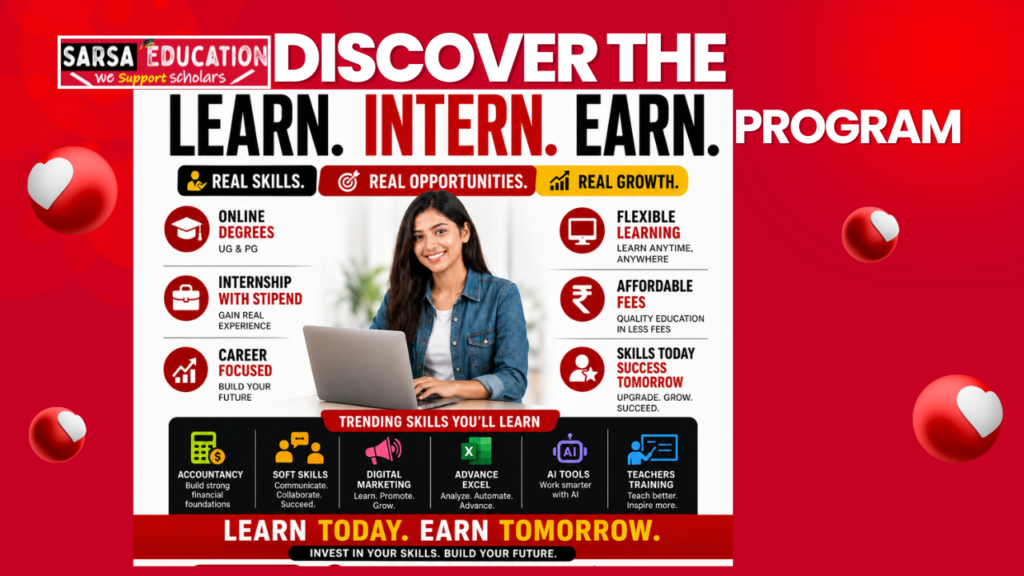
At Sarsa Education, students are encouraged to follow the Learn, Intern & Earn model where they gain both education and real-world exposure.

Importance of Internships in AI Careers
Internships are one of the best ways to improve Skills for AI Jobs.
Benefits of Internships:
- Real-world learning
- Industry exposure
- Resume building
- Networking opportunities
- Improved confidence
- Better placement chances
Students who complete internships during college often receive better career opportunities after graduation.
Highest Paying AI Careers in 2026
AI careers are among the highest-paying professions globally.
1. AI Engineer
Average Salary:
- India: ₹8–25 LPA
- Global: $100,000+
2. Data Scientist
Average Salary:
- India: ₹10–30 LPA
Data Science remains one of the best career options.
3. Machine Learning Engineer
Average Salary:
- India: ₹12–35 LPA
Professionals with advanced Skills for AI Jobs can earn exceptional salaries.
4. AI Product Manager
These professionals manage AI-based product development.
5. Robotics Engineer
Automation and robotics industries are growing rapidly.
6. Prompt Engineer
Prompt Engineering is one of the newest AI career paths.
Prompt Engineers create effective instructions for AI systems.
Industries Hiring AI Professionals
AI opportunities exist across multiple sectors.
Healthcare
AI is used for:
- Disease detection
- Patient monitoring
- Medical imaging
Finance
AI improves:
- Fraud detection
- Banking automation
- Financial forecasting
Education
Educational institutions use AI for:
- Personalized learning
- Virtual tutoring
- Student analytics
Marketing
AI helps businesses with:
- Customer targeting
- Social media automation
- Content generation
E-Commerce
AI powers:
- Product recommendations
- Customer support
- Consumer behavior analysis
Cybersecurity
AI helps companies detect threats and protect sensitive data.
Future Trends in AI Careers
The future of AI is extremely exciting.
1. Generative AI Growth
AI-generated text, images, and videos are becoming mainstream.
2. AI Automation
Businesses will increasingly automate repetitive operations.
3. AI in Healthcare
Healthcare industries will continue using AI-powered diagnostic systems.
4. Ethical AI
Companies will require professionals who understand ethical AI usage.
5. Human + AI Collaboration
AI will support human productivity rather than replace all jobs.
Students with modern Skills for AI Jobs will remain highly valuable.
Important links:
- Online BBA Course, It’s cost & benefits
- Online BCA Course, It’s cost & benefits
- Online MCA Course, Its cost & benefits
- Online MBA Programs , Its Cost and Benefits
Challenges Students Face While Learning AI
Although AI offers massive opportunities, students often face challenges.
1. Lack of Proper Guidance
Many students are unsure where to begin.
2. Fear of Coding
Beginners often think programming is too difficult.
3. Lack of Practical Learning
Theory alone is not enough in AI careers.
4. Rapidly Changing Technology
Students must continuously update their Skills for AI Jobs.
5. Information Overload
Too many online resources can confuse beginners.
This is why structured mentorship and career guidance are important.
How Sarsa Education Helps Students Build AI Careers
Sarsa Education focuses on industry-oriented learning and practical skill development.
We help students prepare for future-ready careers through:
- Career counseling
- Internship opportunities
- Skill development support
- Learn, Intern & Earn programs
- Placement assistance
- Industry-focused training
- Career guidance sessions
Students interested in AI, business analytics, digital marketing, and technology careers can benefit from programs designed to improve practical Skills for AI Jobs.
By combining education with real-world exposure, students become industry-ready professionals.

Why Skills Matter More Than Degrees in 2026
The hiring landscape is changing rapidly.
Today, companies focus more on:
- Practical knowledge
- Industry exposure
- Portfolio projects
- Internship experience
- Communication skills
- Problem-solving abilities
Students who focus on building practical Skills for AI Jobs often gain better opportunities than candidates with only theoretical knowledge.
AI Careers for Non-Technical Students
AI careers are not limited to engineers.
Non-technical students can also build careers in:
- AI Marketing
- AI Content Creation
- AI Business Analytics
- Prompt Engineering
- AI Sales Automation
- Digital Strategy
Commerce and arts students can also learn AI tools and digital skills successfully.
Best AI Tools Students Should Learn in 2026
ChatGPT
Useful for:
- Content generation
- Research
- Coding support
- Productivity
Canva AI
Helpful for:
- Graphic design
- Social media content
- Presentations
Midjourney
AI-powered image generation tool.
TensorFlow
Used for Machine Learning development.
Power BI
Important for analytics and data visualization.
Notion AI
Useful for productivity and project management.
Learning these tools can significantly improve Skills for AI Jobs.
Scope of AI Careers in India
India is becoming a major global technology hub.
Cities offering strong AI opportunities include:
- Bangalore
- Hyderabad
- Pune
- Chennai
- Mumbai
- Delhi NCR
Both startups and multinational companies are actively hiring AI professionals.
Government initiatives promoting digital transformation are also increasing the demand for Skills for AI Jobs.
Final Thoughts
Artificial Intelligence is shaping the future of careers. In 2026, students who develop modern Skills for AI Jobs will have access to excellent opportunities across industries.
Whether you want to become an AI Engineer, Data Scientist, Prompt Engineer, AI Content Strategist, or Business Analyst, continuous learning and practical exposure are the keys to success.
The future belongs to students who adapt, innovate, and build future-ready skills.
At Sarsa Education, we encourage students to focus on internships, practical learning, and career-oriented education so they can confidently succeed in the AI-driven world.
If you start today, your AI journey can lead to high salaries, global opportunities, remote work options, and long-term career growth.
The best time to start building Skills for AI Jobs is now.
Frequently Asked Questions (FAQs)
1. What are the most important Skills for AI Jobs in 2026?
Programming, Machine Learning, Data Science, AI tools, communication skills, and problem-solving abilities are among the most important skills.
2. Can beginners learn AI skills easily?
Yes, beginners can start with Python, basic data analysis, and AI tools step-by-step.
3. Which programming language is best for AI?
Python is considered the best programming language for Artificial Intelligence and Machine Learning.
4. Are AI jobs high paying?
Yes, AI professionals often receive higher salary packages compared to many traditional career paths.
5. Can non-technical students work in AI?
Yes, non-technical students can enter AI-related careers such as AI marketing, analytics, and prompt engineering.
6. Is coding mandatory for AI careers?
Some AI roles require coding, while others focus on AI tools, analytics, and business applications.
7. What is the future scope of AI in India?
India has huge growth potential in AI because of increasing digital transformation and startup innovation.
8. How can internships help in AI careers?
Internships provide practical exposure, industry experience, networking opportunities, and better placement chances.
9. What are the best courses for AI careers?
B.Tech AI, BCA AI, MCA, MBA Analytics, and online AI certifications are among the best choices.
10. How long does it take to learn AI skills?
Basic AI skills can be learned within a few months, while advanced expertise requires continuous practice.
11. What industries hire AI professionals?
Healthcare, finance, education, marketing, cybersecurity, and e-commerce industries hire AI professionals.
12. What is Prompt Engineering?
Prompt Engineering involves creating effective instructions for AI systems to generate accurate outputs.
13. Do AI jobs offer remote work?
Yes, many AI-based careers provide remote and hybrid work opportunities.
14. Why are Skills for AI Jobs important in 2026?
AI adoption is increasing rapidly, creating huge demand for skilled professionals.
15. How can Sarsa Education help students build AI careers?
Sarsa Education supports students through career guidance, internships, skill-based learning, and placement assistance.
16. Is AI a good career after 12th?
Yes, students can pursue AI-related courses after 12th and build successful careers.
17. Which AI tools should students learn?
Students should learn ChatGPT, TensorFlow, Power BI, Canva AI, and data analytics tools.
18. What soft skills are important for AI careers?
Communication, creativity, teamwork, adaptability, and problem-solving are essential.
19. What is the average salary of an AI Engineer in India?
AI Engineers in India can earn between ₹8–25 LPA depending on experience and expertise.
20. How can students stay updated in AI?
Students should follow industry blogs, online courses, webinars, AI communities, and practical projects regularly.
21. What are the best AI tools for students in 2026?
ChatGPT, Gemini, Canva AI, TensorFlow, Power BI, and Midjourney are among the best tools.
22. Is Artificial Intelligence difficult to learn?
AI can seem complex initially, but with proper guidance and regular practice, students can learn it successfully.
23. Can commerce students build careers in AI?
Yes, commerce students can enter AI fields like business analytics, automation, and digital strategy.
24. What is the role of Data Science in AI?
Data Science helps AI systems process and analyze data for intelligent decision-making.
25. Why should students focus on Skills for AI Jobs instead of only degrees?
Modern companies prefer candidates with practical skills, internships, portfolios, and real-world experience over theoretical knowledge alone.
For National/International Scholarship updates kindly join our WhatsApp channel
Follow the Sarsa Education channel on WhatsApp: https://whatsapp.com/channel/0029VaL9SgRAjPXJthnK9D0E
In case of any queries, please reach out to:
+91-9156405182 (Monday to Friday – 10:00 AM to 06:00 PM (IST))
For regular Scholarship/Fellowship/Internship updates:
Join our Telegram channel: Sarsa Education